ALIA project: language learning in the age of AI
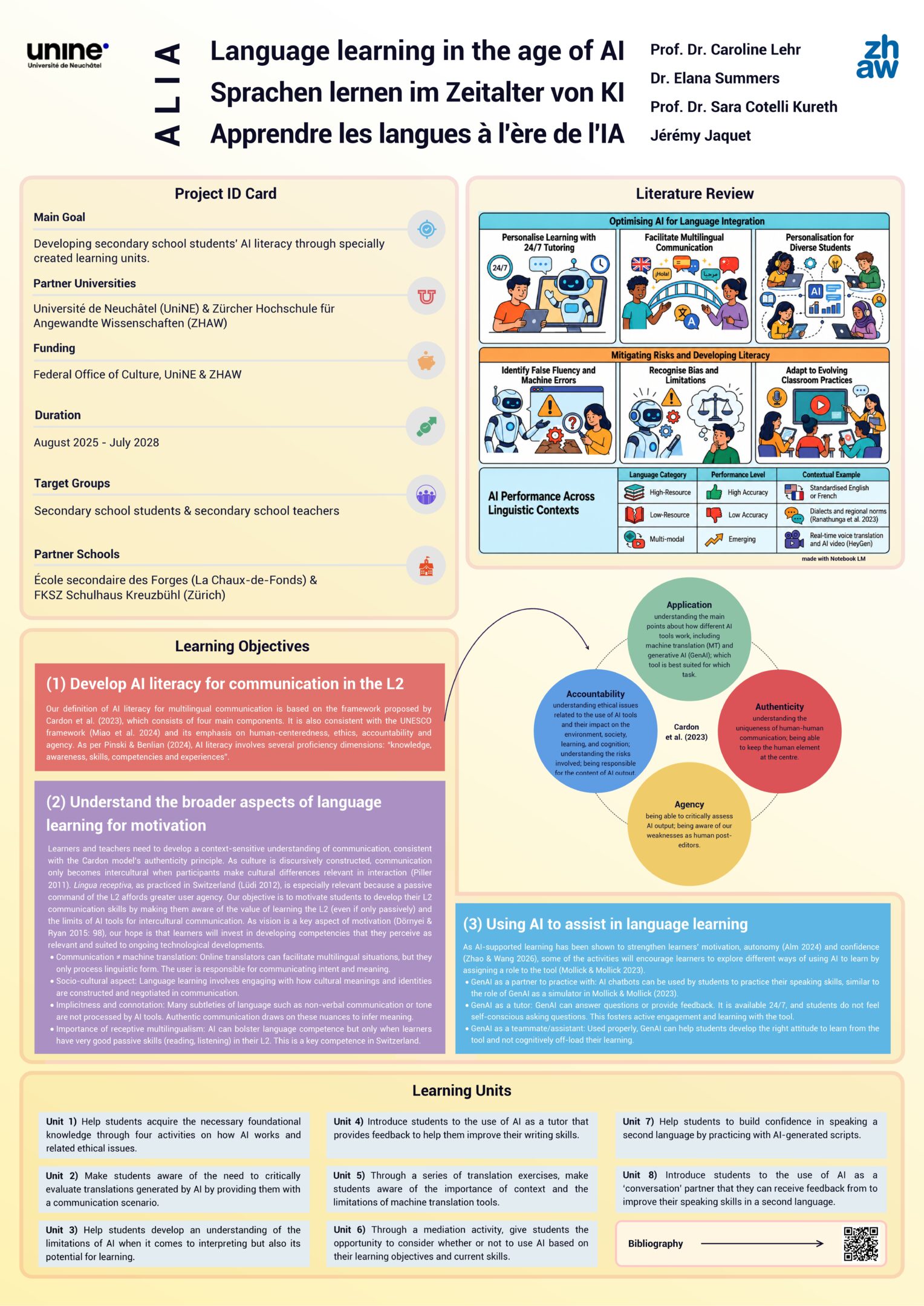
Writing a text or creating a video in a language that you don’t speak fluently is now possible thanks to generative artificial intelligence (GenAI) tools. Yet this technological achievement is triggering both a revolution in language learning and a deeper debate about its very purpose. Some voices in the media prophesy the end of language teaching, while others now claim it has become pointless. In light of this situation, how can we support teachers and students in turning GenAI into an ally rather than something imposed on them, while continuing to give meaning to language learning? This is precisely the challenge the ALIA project seeks to address.
Background
To date, many foreign language teachers have responded to the rise of GenAI by placing greater emphasis on speaking skills in teaching and assessment, for example by introducing oral exams or asking students to submit videos or audio recordings instead of written texts (Bower et al. 2024). Yet when properly harnessed, GenAI can also work to the advantage of teachers and students alike, for instance by enabling a more tailored approach that responds to each learner’s particular needs (CIIP 2025).
That said, while GenAI has been shown to facilitate multilingual communication in many contexts (Klimova et al. 2022), it is important to keep its limitations in mind. GenAI performs less well in low-resource languages (see Ranathunga et al. 2023), it can contain biases and stereotypes, and it tends to produce standardized language that struggles to capture the specific characteristics of German or French as spoken in Switzerland.
In multilingual Switzerland, it is therefore crucial that students – the citizens of tomorrow – develop the skills needed to use AI in critical, reflective and sustainable manner. A strong passive command of the foreign language is essential if we are to remain accountable for the messages that we co-create with GenAI.
Project objectives
To provide students and teachers with the best possible support, the ALIA project aims to develop ready-to-use teaching materials for lower secondary education schools (Sekundarstufe I / Cycle 3), made up of eight 45-minute lessons. The learning units are designed to foster AI literacy among students for the purpose of communicating in their foreign language, drawing on four components from Cardon et al.’s (2023) framework:
- Application highlights the importance of having a basic technical understanding of how AI tools work, as well as knowledge of the different tools available and their suitability for a given task.
- Authenticity reminds us that genuine, human-centered communication must always come first.
- Agency means that humans retain control over the communication process, ensuring that we do not become dependent on the machine.
- Accountability emphasizes the importance of transparency, fairness and equity when using AI and the need for us to take responsibility for any content produced with the help of AI.
Alongside these guiding principles, we believe it is essential to focus on student motivation at a time when the need to learn foreign languages is being questioned more than ever. Motivation plays a decisive role in learning success, and learners are motivated to prioritize the development of skills that they perceive as relevant and suited to new technological developments. As a result, they will be able to develop a future-oriented vision while at the same time strengthen their self-efficacy in learning foreign languages (Dörnyei & Ryan 2015).
Bower, M., Torrington, J., Lai, J. W. M., Petocz, P. & Alfano, M. (2024). How should we change teaching and assessment in response to increasingly powerful generative Artificial Intelligence? Outcomes of the ChatGPT teacher survey. Educ Inf Technol, 29. https://doi.org/10.1007/s10639-023-12405-0
Cardon, P., Fleischmann, C., Artiz, J., Logemann, M. & Heidewald, J. (2023). The challenges and opportunities of AI-assisted writing: Developing AI literacy for the AI age. Business and Professional Communication Quarterly, 86(3) https://doi.org/10.1177/23294906231176517
CIIP (2025). Intelligence artificielle générative – IAG. Recommandations pour une utilisation réfléchie et mesurée dans l’enseignement. Accès : https://www.ciip.ch/files/1050/Documents/IRDP/Recommandations_IAG_19-03-2025_V10.pdf
Dörnyei, Z., & Ryan, S. (2015). The Psychology of the Language Learner Revisited (1st ed.). New York, Routledge. https://doi.org/10.4324/9781315779553
Klimova, B. et al. (2023). A Systematic Review on the Use of Emerging Technologies in Teaching English as an Applied Language at the University Level. Systems, 11. https://doi.org/10.3390/systems11010042
Ranathunga, S. et al. (2023). Neural Machine Translation for Low-resource Languages: A Survey, ACM Computing Surveys, 55, 1-37. https://doi.org/10.1145/3567592
- Prof. Dr. Sara Cotelli Kureth (UniNE)
- Prof. Dr. Caroline Lehr (ZHAW)
- Jérémy Jaquet (UniNE)
- Dr Elana Summers (ZHAW)
- University of Neuchâtel (UniNE)
- Zurich University of Applied Sciences (ZHAW)
- Federal Office of Culture (CHF 180,000)
- Start: September 2025
- End: August 2028
- École secondaire des Forges (La Chaux-de-Fonds)
- FKSZ Schulhaus Kreuzbühl (Zürich)