Research Project
Water Crimes – Unpunished Wrongdoing
A Research Project in the Shallow Waters of Criminal Prosecution

Description

Team

Publications
Funded by the Swiss National Science Foundation for a period of 48 months (09/2025 – 08/2029).
SNSF project 10003656
Project duration: 2025–2029
Project description
Summary
Water crimes, understood as unlawful acts that compromise the quality or availability of water resources and are subject to criminal sanction, is attracting increasing public attention. In the context of climate change and a growing global demand for water, this resource is becoming a central issue of social conflicts. Calls for stronger criminal law protection are therefore intensifying. Yet, criminal justice practice in the field of water-related offences continues to fall markedly short of societal expectations. This situation not only produces severe ecological and social consequences but also undermines confidence in the rule of law’s capacity to safeguard fundamental living conditions.
This research project, funded by the Swiss National Science Foundation (SNSF) and conducted at the Faculty of Law of the University of Neuchâtel, addresses this issue from interdisciplinary perspectives: legal, socio-legal, and criminological. The focus lies on questions concerning the functioning and performance of criminal prosecution, as well as the scope and adequacy of the applicable criminal provisions, the social practices relating to legally regulated water protection, and the situational factors that foster water-related delinquency. The project thus combines a dogmatic legal analysis with a socio-legal study of the implementation of criminal regulation and examines the conditions under which criminal law can effectively fulfil its protective function in this field.
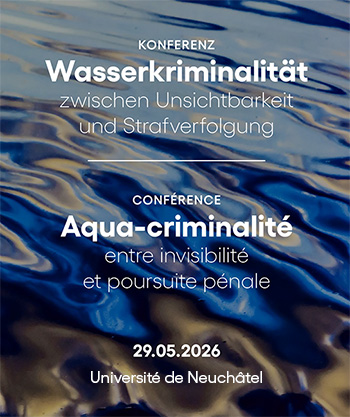
Conference
Aqua-criminalité – Wasserkriminalität
entre invisibilité et poursuite pénale – zwischen Unsichtbarkeit und Strafverfolgung
29.05.2026
University of Neuchâtel
Team
Project leader
Prof. Dr. Nadja Capus
Faculty of Law
University of Neuchâtel
Researchers
- Dr. rer. soc. Franziska Hohl Zürcher, Post-doctoral fellow
- Dr Sophie Serrano, Post-doctoral fellow
- Leonardo Gomez Mariaca, PhD Candidate
- Erik Meier, Student assistant
Publications
In preparation

