
Credits validation for DSLS members
As part of their doctoral training at the Doctoral School in Life Sciences (DSLS), PhD candidates must complete 12 credits in total, distributed across three categories:
- Research Tools
- Scientific Activities
- Transferable Skills
Rules for credit distribution
- Each category requires a minimum of 4 credits.
- Within each category:
- 2 credits must be validated through internal activities (DSLS Program).
- 2 credits must be validated through external activities (e.g., CUSO courses, conferences, workshops).
This ensures a balanced training combining DSLS-specific courses and external opportunities.
How to Earn Credits?
Credits can be earned through:
- Courses, workshops, or activities organized such as :
- Internal activities : Doctoral Schoold in Life Sciences (DSLS) activity program
- External activities : CUSO Biology programs & CUSO Transferable Skills program & other recognized opportunities (ateliers REGARD, Equality Office, LS2, etc.)
- Presentations at international/national conferences, seminar, symposium
-
First-author or co-author publications in peer-reviewed journals
- Science outreach activities
How to Validate Credits?
-
- Attend the course, workshop, or activity.
- Obtain a certificate of participation.
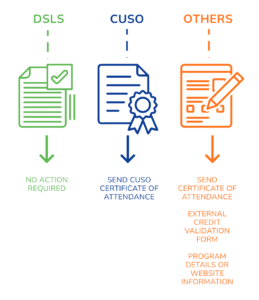
- For activities completed outside the DSLS doctoral program (e.g., conferences, seminars, workshops, outreach events), please attach the External Credit Validation Form. For conferences, make sure to include the abstract, the event website, and the program. All CUSO activities can be validated by sendingthe CUSO certificate of attendance to ds.biology@unine.ch.
- For activities completed within the DSLS doctoral program the credits will automatically be validated by the academic coordinator.
Credit Value
- 1 credit = approx. 14 hours (2 full days of workshops)
- 1 oral presentation (~15 min) = 1 credit
- 1 poster presentation = 0.5 credit
- 1 first-author publication = 1 credit
- 1 outreach activity or event organization = 1 credit
For more details, see the example list of credit validation by activity.
Credit validation procedure
Transferable skills (T)
Competences that are transferable to other career paths than academia:
e.g., Scientific writing, Public speaking, Project management, Outreach events, etc.

Research tools (R)
Practical skills or specific scientific technics :
e.g., Biostatistics, Statistical softwares, Microscopy, Sequencing, etc.

Scientific activities (S)
e.g., Presentations at conferences or seminars, scientific workshops (e.g., Open Science, Agriculture, Animal Behaviour, etc.)