Événements
Jeudi, 12h15-13h15
Salle: F200
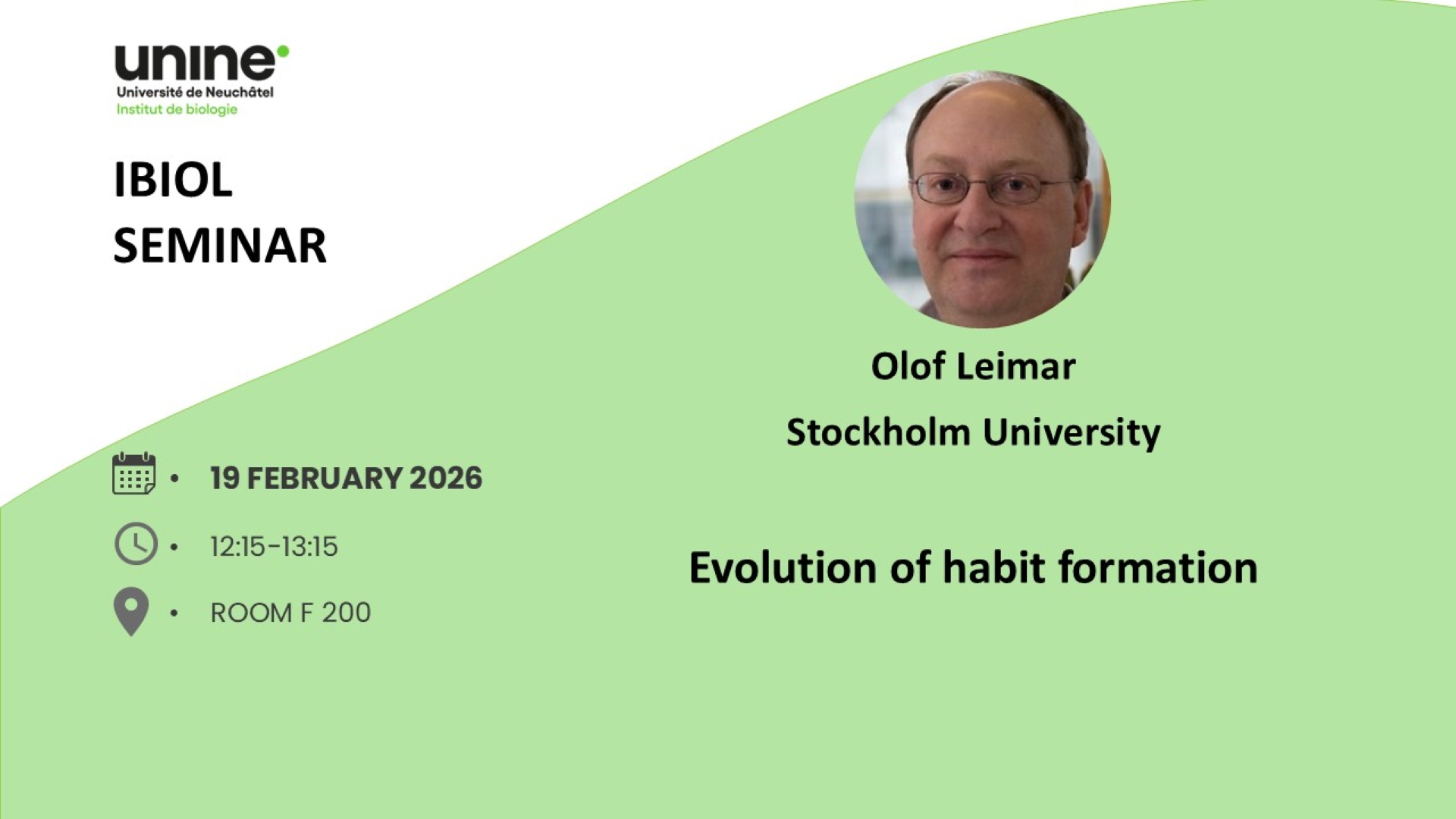
- 19 février: Olof Leimar, Evolution of habit formation,Université de Stockholm (laboratoire d’eco-éthnologie)
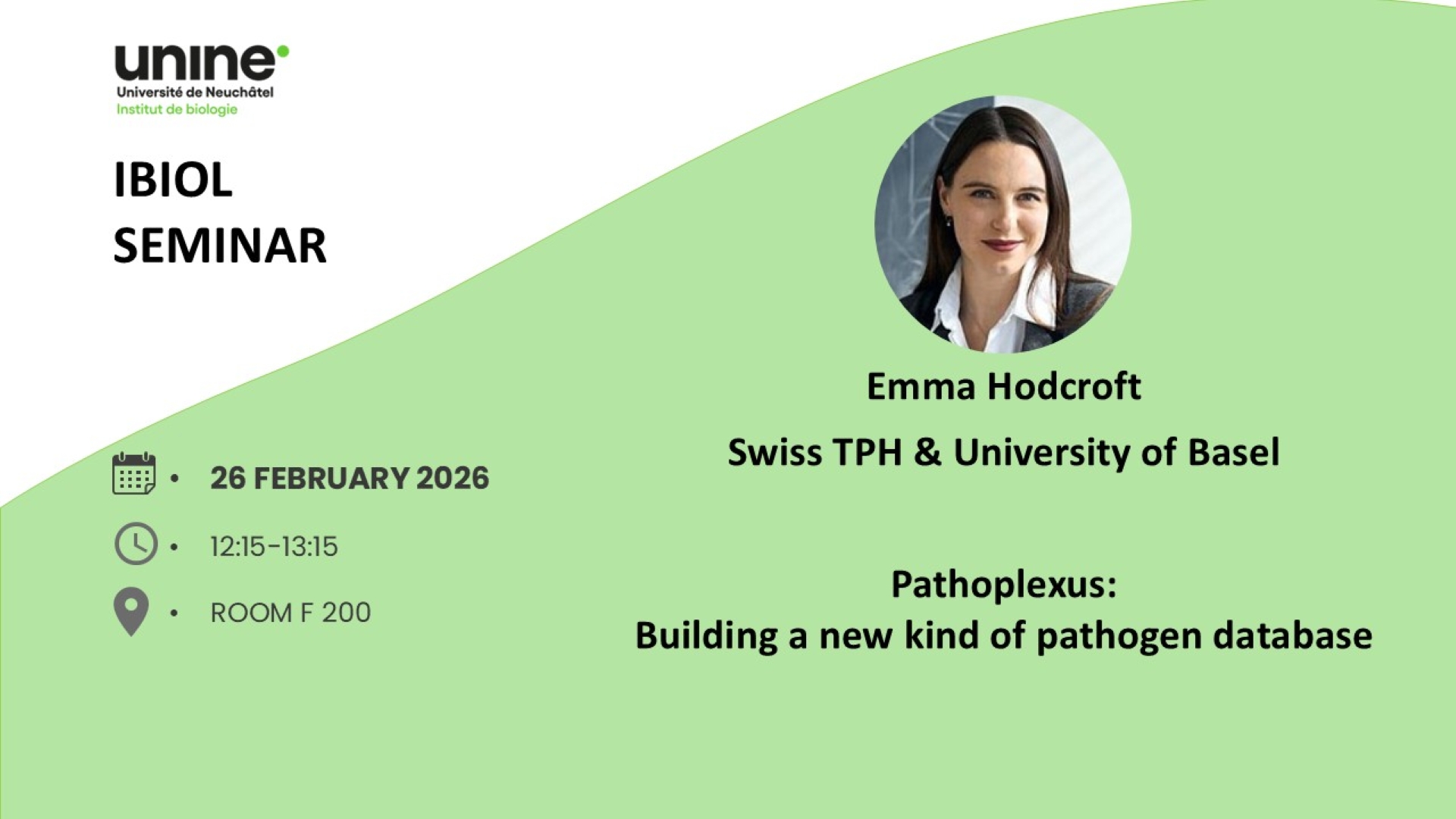
- 26 février: Emma Hodcroft, Pathoplexus: Building a new kind of pathogen database, Swiss TPH & University of Basel (laboratoire de génétique évolutive)
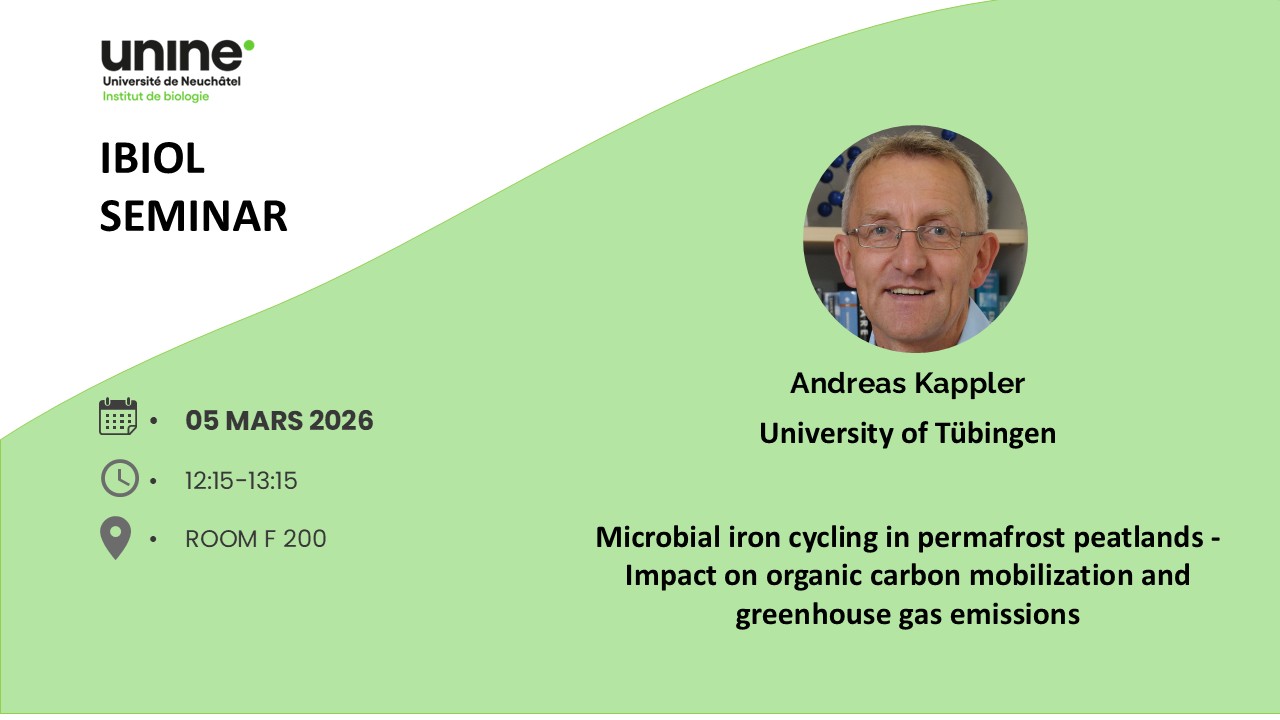
- 5 mars: Andreas Kappler, Microbial iron cycling in permafrost peatlands-Impact on organic carbon mobilization and greenhouse gas emissions, University of Tübingen (laboratoire de microbiologie)
- 19 mars: Heike Lindner, Stay hydrated – Deciphering the development and physiology of leaf succulence, University of Bern – Institute of Plant Sciences (Plant developmental plasticitisité)
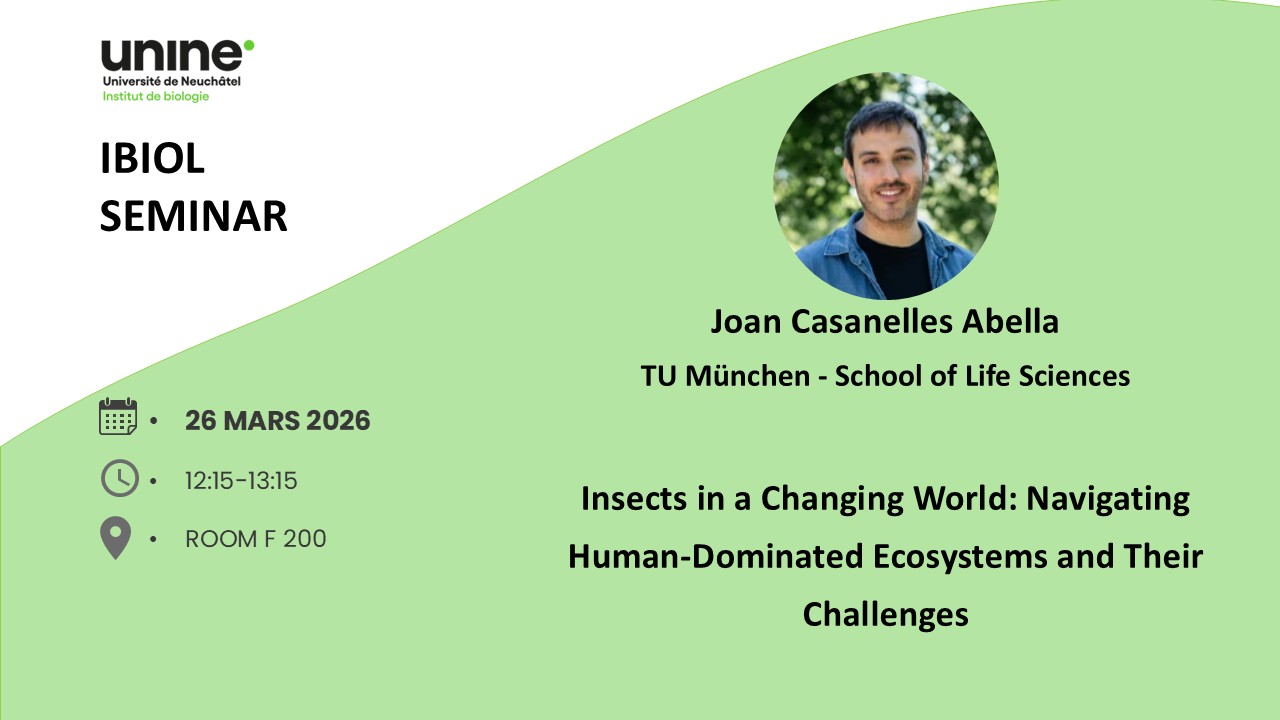
- 26 mars: Joan Casanelles Abella, Insects in a Changing World: Navigating Human-Dominated Ecosystems and Their Challenges, TU München – School of Life Sciences (laboratoire d’ecologie functionnel)
- 2 avril: Ek del Val de Gortari, Arthropods in the new agricultural era: how bugs are responding to new management approaches in milpa fields, UNAM (laboratoire d’écologie chimique)
- 16 April: Jeremy Gauthier, Museomics as a window into long-term insect population decline, Naturéum Lausanne (laboratoire de génomique de biodiversité)
- 23 April: Philippe Reymond, Extracellular conversion of an insect egg-derived phospholipid elicitor triggers immune responses in Arabidopsis, Université de Lausanne (laboratoire de biologie cellulaire et moléculaire)
- 30 avril: Pete Buston, Social Evolution in Clownfish, Boston University(laboratoire de physiologie animale)
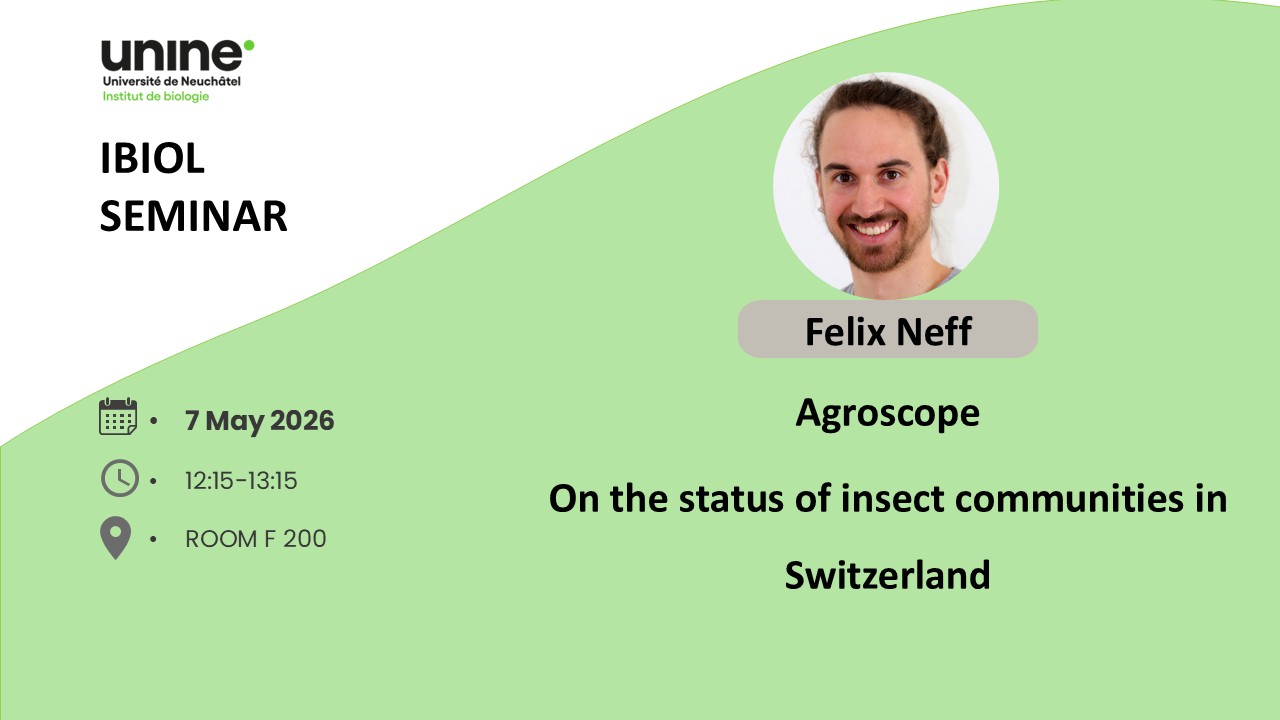
- 7 May: Felix Neff, On the status of insect communities in Switzerland, Agroscope (laboratoire de la conservation)
- 21 mai: Mathieu Perret, Phylogenomics for biodiversity assessment of regional flora in Switzerland, Conservatoire et Jardin Botaniques de Genève (laboratoire de biodiversité du sol)
- 28 Mai: Nicolas Mathevon, The voices of Nature. How and Why Animals Communicate, Université de Saint-Etienne (laboratoire de cognition comparée)
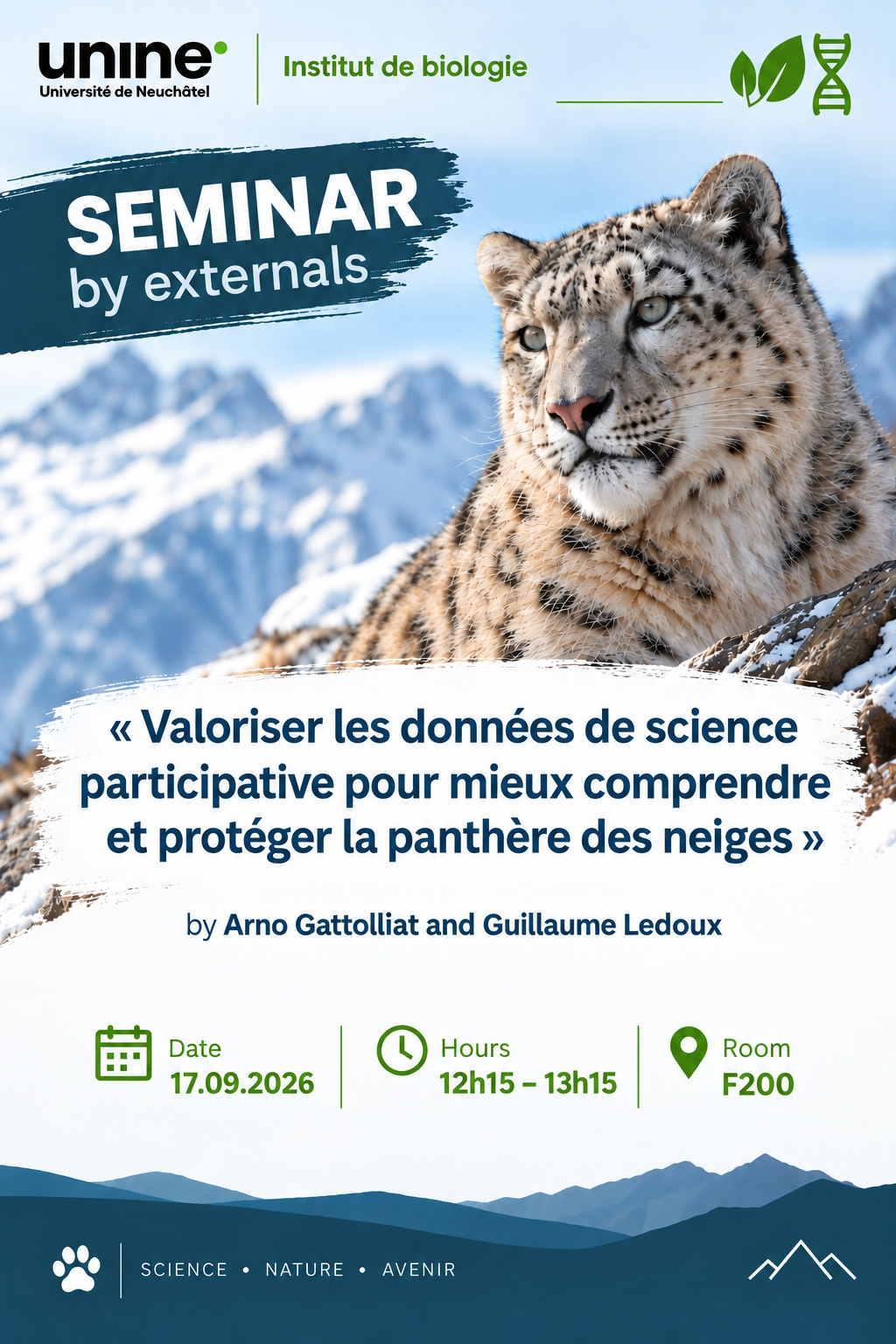
- 17 Septembre: Arno Gattolliat and Guillaume Ledoux(Unine), Valoriser les données de science participative pour mieux comprendre et protéger la panthère des neiges
- 24 Septembre: Alexandre Jousset, Microbiome digital twin for rational probiotic design, Genedance/Nanjing Agriculture university (laboratoire biodiversité du sol)
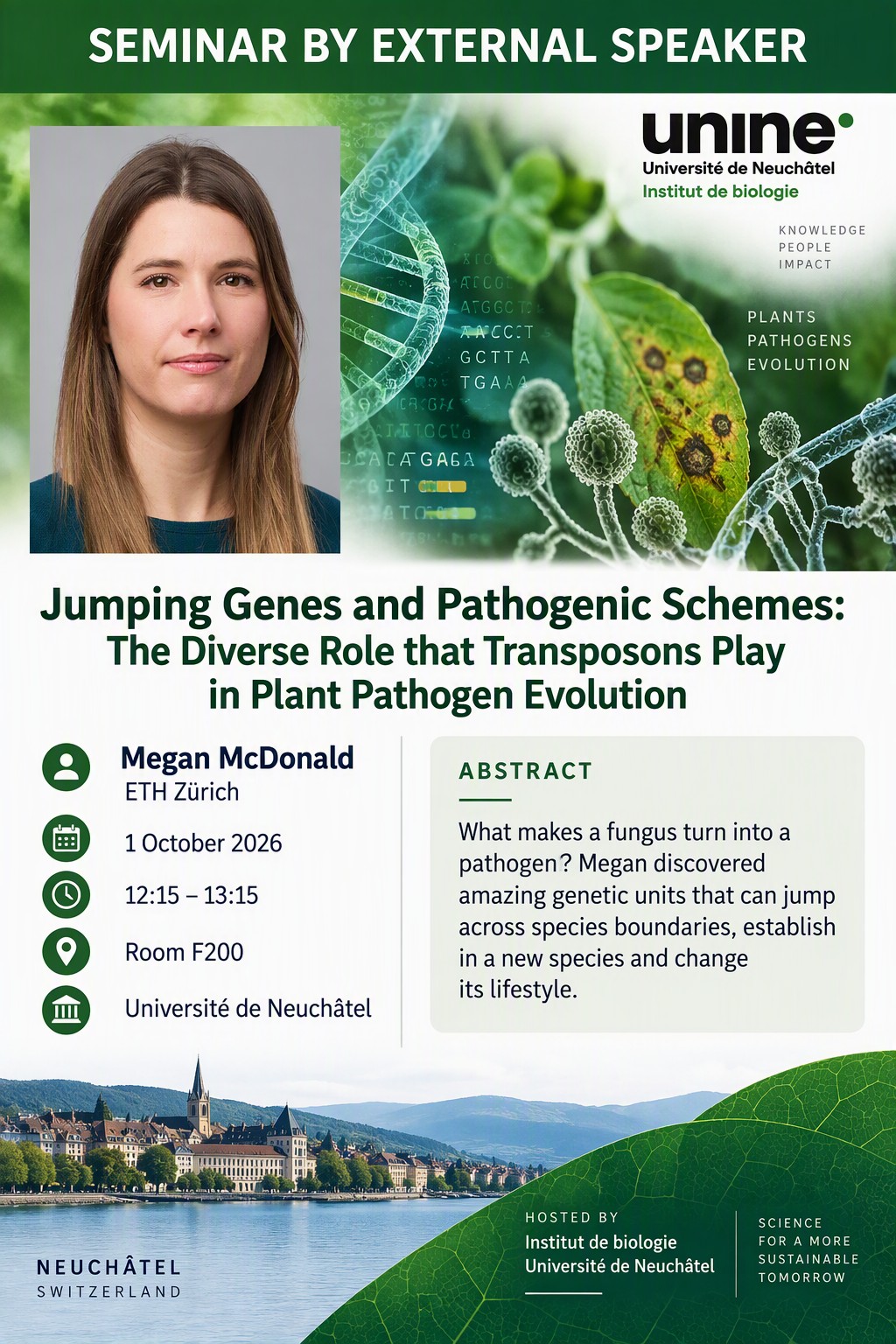
- 1 Octobre: Megan McDonald, Jumping Genes and Pathogenic Schemes: The diverse role that transposons play in plant pathogen evolution, ETH Zurich (laboratoire génétique-évolutive)
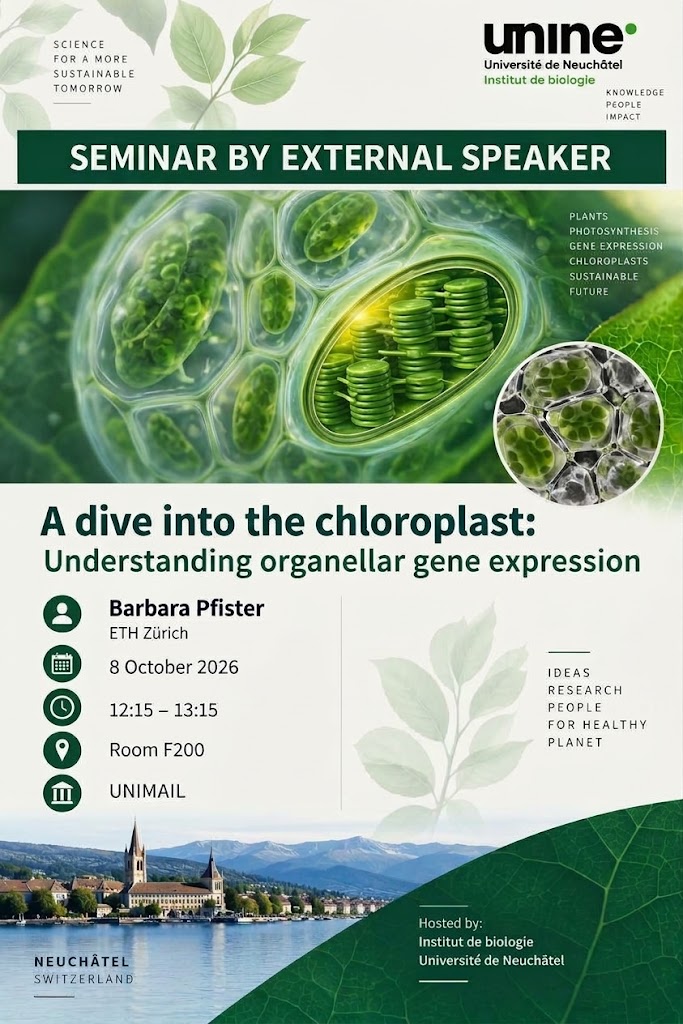
- 8 Octobre: Barbara Pfister, A dive into the chloroplast: Understanding organellar gene expression, ETH Zurich (laboratoire physiologie végétale)
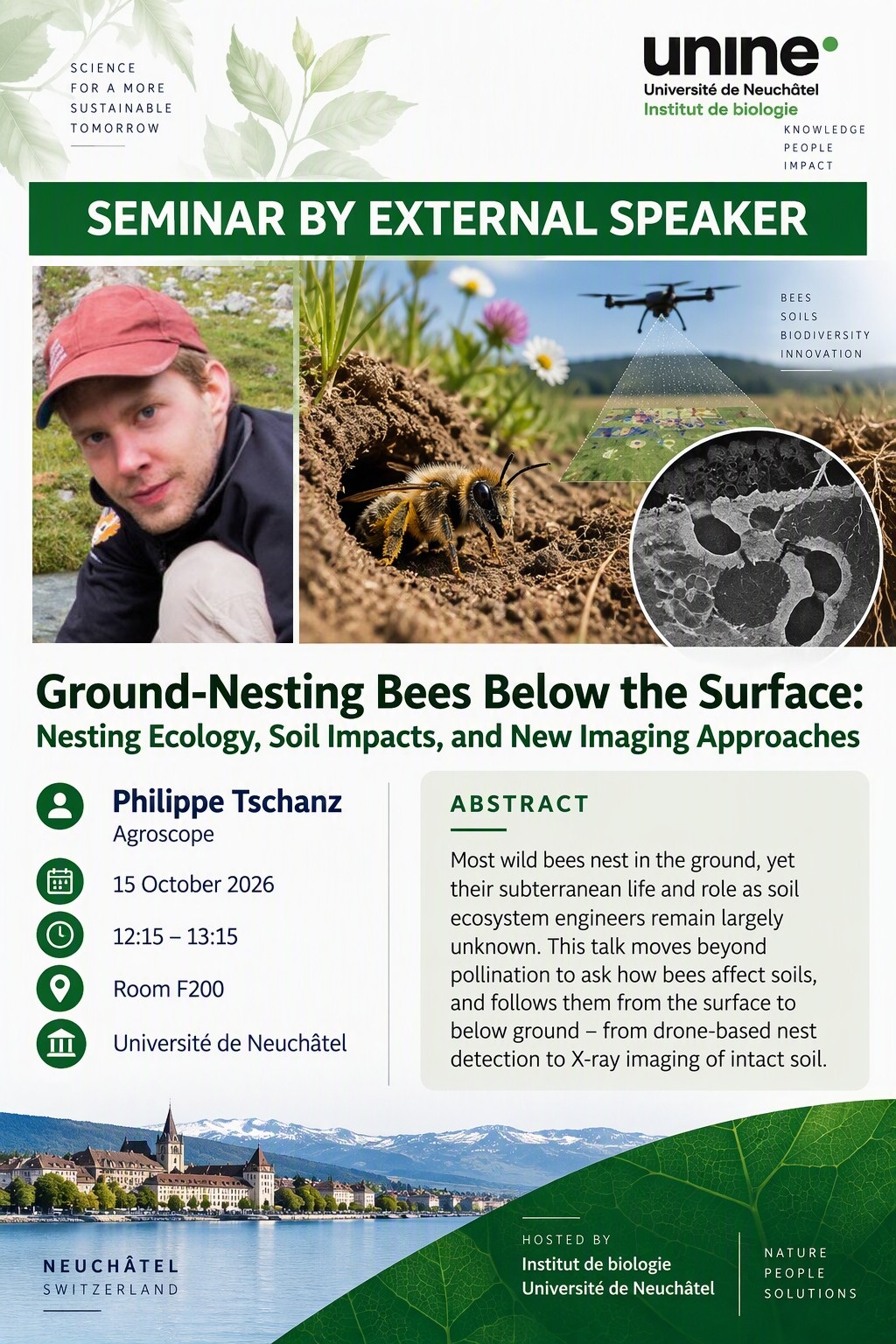
- 15 Octobre: Philippe Tschanz, Ground-nesting bees below the surface: Nesting ecology, soil impacts, and new imaging approaches, Agroscope (laboratoire ecologie chimique)
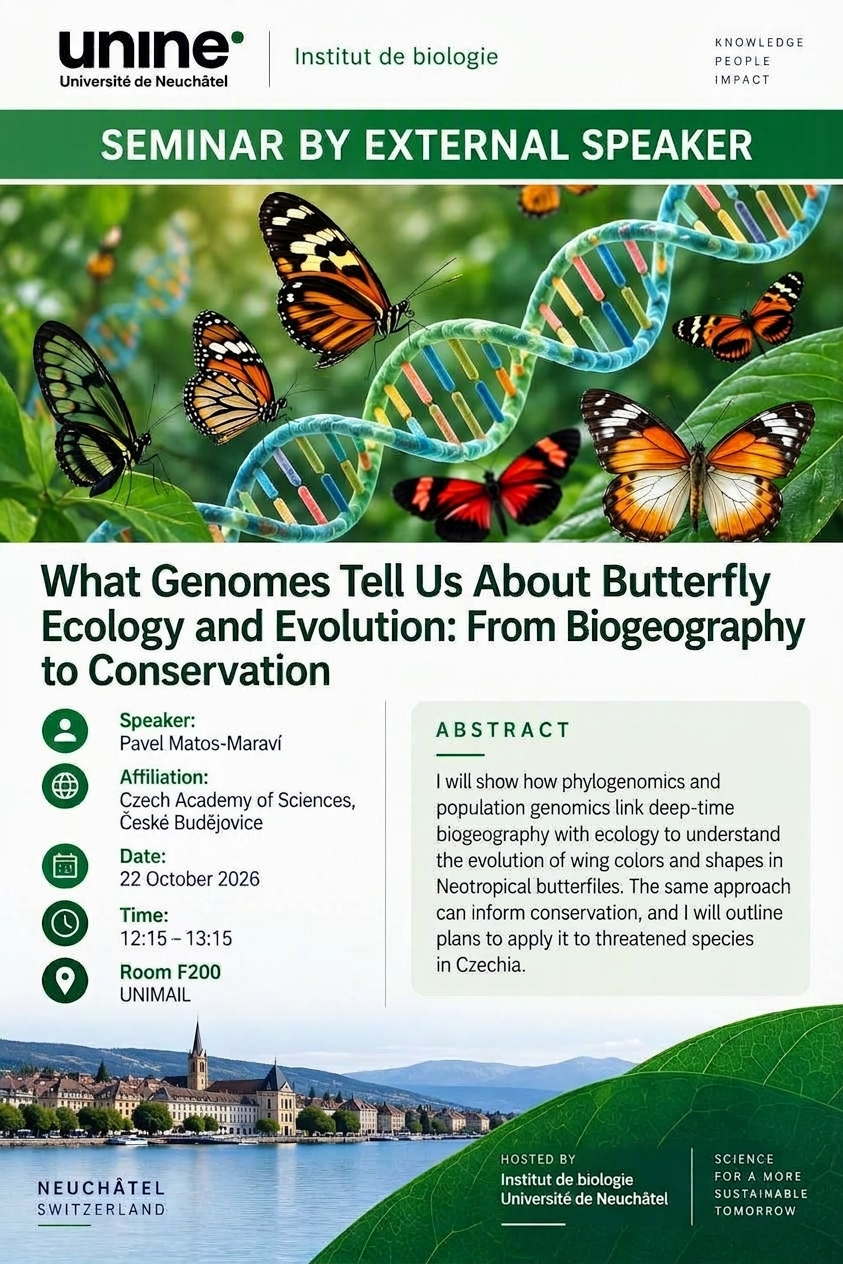
- 22 Octobre: Pavel Matos-Maravi, What genomes tell us about butterfly ecology and evolution: from biogeography to conservation; Czech Academy of Sciences České Budějovice (laboratoire génomique de la biodiversité)
- 29 Octobre: Pavel Nemec, Neuron Numbers in Vertebrates: A Story of the Independent Origins of Complex Brains; Univerzita Karlova v Praze (laboratoire physiologie comportementale)
- 5 Novembre: Emilio Guerrieri, CNR Italia
- 19 Novembre: Leonie Lugenbuehl, University Geneva
- 3 Decembre: Marine Mamin, chemical ecology of fungi and bark beetle interactions, Max Planck Institute for Chemical ecology
- 10 Decembre: Charles Mullon, UniL
- 17 Decembre: Sarah Marshall-Pescini, Urban wolves and free-ranging dogs, VetMed University Vienna
Seminar in Biodiversity Conservation
Autumn 2026
This seminar takes place on Thursdays, 15h15 – 17h00, in the room F200
| 17-Sept | Clara Zemp
Ellen Martin Christophe Praz |
UniNe ( Institute of biology ) | Conservation biology |
| 24-Sept | Sergio Rasmann
Edward Mitchell |
UniNe ( Institute of biology ) | Functional biology
Soil biodiversity |
| 01-Oct | Kay Lucek
Daniel Croll |
UniNe ( Institute of biology ) |
Evolutionary genetics
Biodiversity genomics |
| 08-Oct | Redouan Bshary
Zegni Tricky Gwen Wirobski |
UniNe ( Institute of biology )
|
Animal behavior
Comparative cognition |
| 15-Oct | Pilar Junier
Saskia Bindschedler |
UniNe ( Institute of biology )
|
Microbiology |
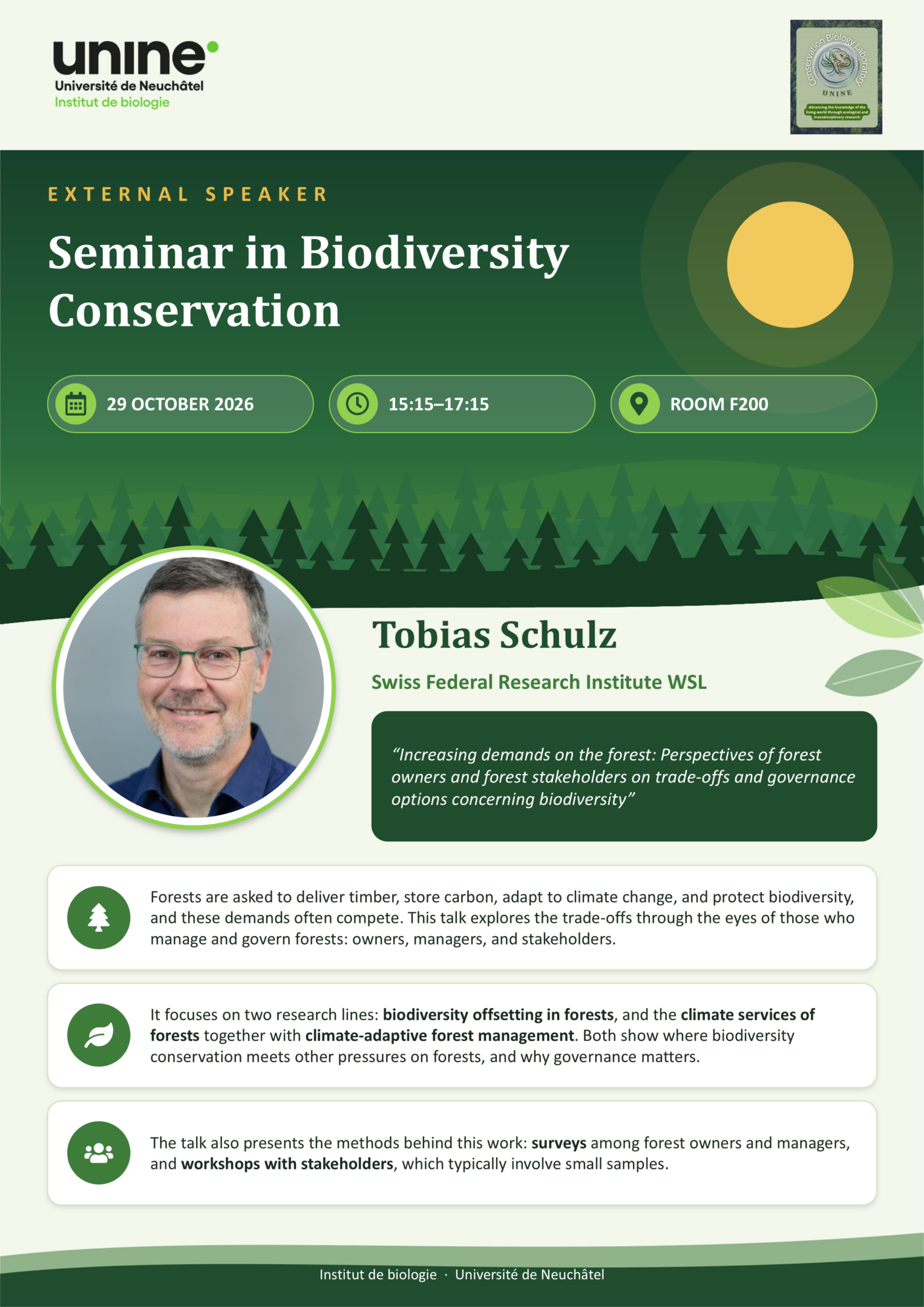
| 29-Oct | Tobias Schulz | Swiss Federal Institute for Forest, Snow and Landscape Research (WSL) | Climate Change, Forest Biodiversity and Forest Governance |
| 5-Nov | Jane Carter |
HELVETAS |
TBD |
| 12-Nov | Thomas Wirth | WWF | TBD |
| 19-Nov | Cécile Fattebert | International Union for Conservation of Nature (IUCN) | Who builds whose capacities? Reflections on Knowledge Transfer and Mutual Learning |
| 26-Nov | Jérôme Frei | Federal Office for the Environment (FOEN) | Monitoring and policy evaluation in the domain of biodiversity in Switzerland |
| 3-Dec | Michele Sofisti | NZATU | TBD |
| 10-Dec | PJ Stephenson | IUCN / UniL | Biodiversity monitoring for conservation in the Anthropocene: challenges and opportunities |
Mercredi, 12:15-13:30
Auditoire F 200
- 25 mars : TALK1 Branching out: What Early-Diverging Fungi Teach Us About Genetic Regulation. Carlos Lax (génétique évolutive); TALK2 Cell Fate Plasticity During Lateral Root Formatin in Grasses. Marius Malai (biologie moléculaire et cellulaire); TALK3 River Revitalisation for Swiss Wild Bees, Greg Egloff
- 29 avril: TALK 1 The role and mechanisms of polar localization of proteins during phloem development in Arabidopsis. Ambre Dalle; TALK 2 Greening in Plant Embryos: Beneficial, Neutral or Detrimental? Lena Hyvärinen; TALK 3 Is the SOV order truly universal? A comparative approach, Sarah Brocard
- 27 mai: TALK1 How to arthropod predators regulate herbivory in alpine environments? Baptiste Bovay(écologie fonctionelle); TALK2 Selecting maize varieties for improving oder-based, real-time detection of the fall armyworm. Juan Traine (FARCE); TALK3 Can we detect extra-terrestrial microbes?: Winogradsky columns as model ecosystems to investigate how biosignatures change according to microbial metabolisms. Matthilda Fatton(microbiologie)
- 30 septembre: TALK1 Simulating evolution of eukaryote pangenomes; Sam Horsfield (génétique évolutive) TALK2 The epigenomic landscape across Lepidoptera and its role in chromosomal rearrangements. Paula Escuer Pifarré (génomique de la biodiversité); TALK3 Decoding root barriers: from single cells to whole-root architecture, Corentin Maslard (biologie moléculaire et cellulaire)
- 28 octobre: TALK1 Effects of cyanosphere bacteria on the growth of the anatoxin-a producing Microcoleus; Margaux Corset(microbiologie); TALK2 Towards robust and resilient socio-agroecosystems in Swiss agriculture: A participatory action research approach; Sylvain Lanz (biodiversité du sol); TALK3 Variations on Nemo: dynamics of social aggression in a clownfish species; Gabriele Sciamma (physiologie animale)
- 25 novembre
- BIOLOGY 26, 12-13 février 2026, Université de Neuchâtel
- ChemEco26, 11 février 2026, Uninversité de Neuchâtel
- 17 avril 2026 16h: Xuân Thái Bùi: Cell volume regulation during lateral root development in Arabidopsis thaliana (laboratoire de biologie moléculaire et cellulaire)
- 8 mai 2026 17h30: Stéphanie Morelon, Un éclairage multidisciplinaire pour mieux comprendre la diversification récente des plantes alpines calcicoles : le complexe des Primevères auricules comme cas d’étude (laboratoire d’Ecologie fonctionnelle
- 05 juin 2026 17h: Letizia PESSINA, Life history dynamics in the prot ogynous cleaner wrasse Labroides dimidiatus (laboratoire éco-éthnologie)
- 14 août 2026 16h15: Zsófia WINTER, Characterization of MAP70 proteins during root organogenesis in Arabidopsis thaliana, (laboratoire de biologie moléculaire et cellulaire)
- 25 septembre 2026 17h00: Gent Ballabani, Caractérisation du translocon de la membrane externe des chloroplastes du petit pois, (laboratoire de physiologie végétale)
- 23 octobre 2026 17h00: Camille Cornet, Comparative genomics to unravel chromosomal instability in butterflies(laboratoire de génomique de la biodiversité)