Centre of Competence in Chemical Ecology – C3E
In 2014, the University of Neuchâtel defined key areas to highlight original fields of research and innovation, wherein several research teams were united in an interdisciplinary and interfacultary process as Centres of Competence. These key areas crystallised the knowledge that at the time formed the basis of the University of Neuchâtel. They were seen as “an answer to current concerns and issues, as well as to modern technological and social challenges”. Within a participative process the rectorate encouraged the faculties to put forward their key areas of expertise:
- health law
- intellectual property and innovation law
- migration and mobility
- social interaction
- cognitive science
- complex systems and Big Data
- time and frequency and optical metrology
- hydrogeology and geothermics
- chemical ecology
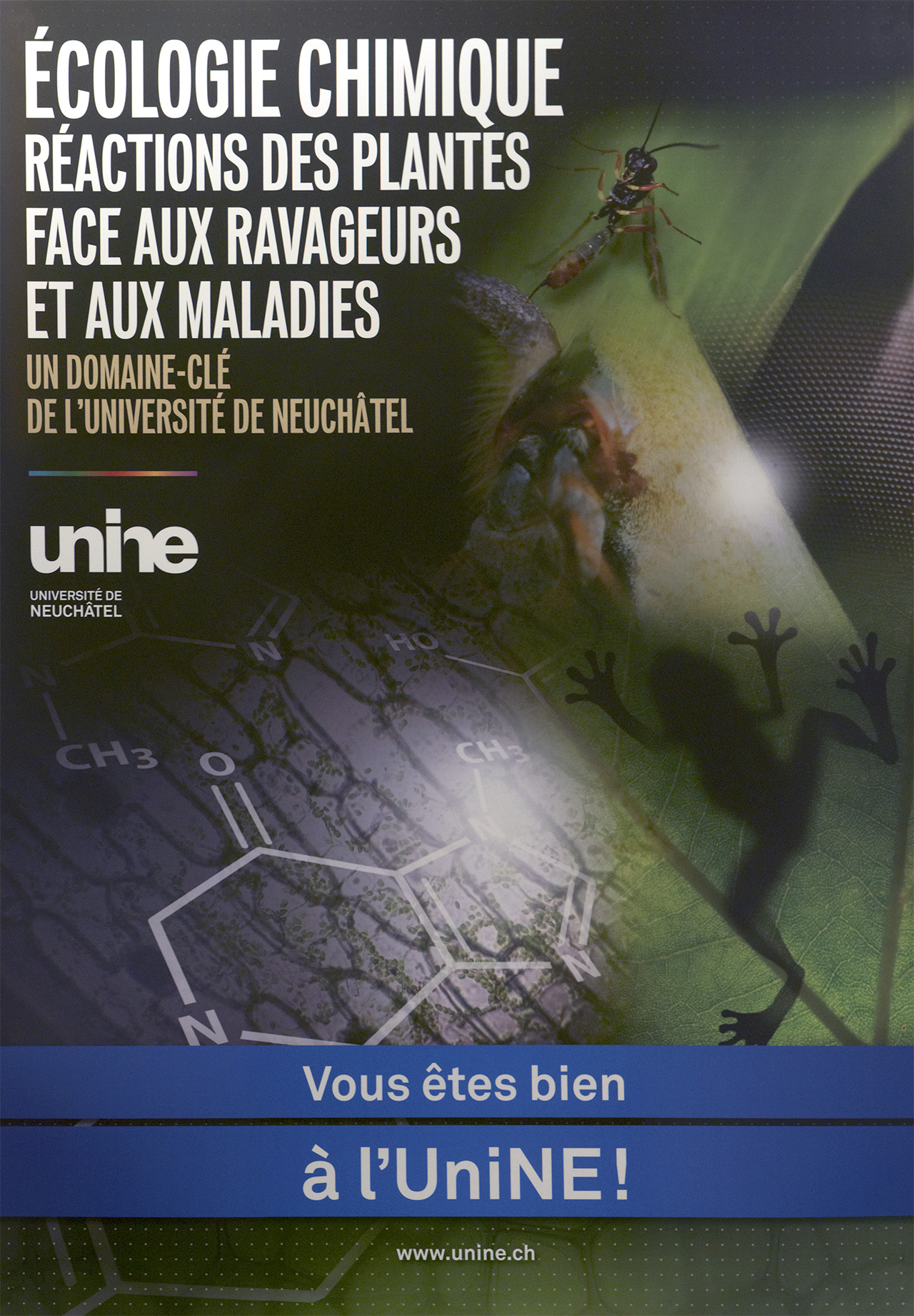
In this process, the Centre of Competence in Chemical Ecology (C3E) was created as a follow-up of the National Centre of Competence in Research Plant Survival (2001-2013), in which research in chemical ecology played a dominant role. Chemical ecology is a highly interdisciplinary field that concerns chemically mediated interactions. It involves, among others, chemists that identify and synthesize bioactive substances, physiologists that study the production and perception of these chemicals in plants and animals, but also ecologists that may study the impact of the chemically mediated interactions at the individual or ecosystem level. Chemical ecology is also all-inclusive at the organismal level and relates to all taxa, ranging from bacteria to humans, and therefore is of great importance to all of biology. Most importantly, the research has great potential for application in the context of food security, ecosystem management, as well as in human and animal healthcare.
C3E comprised a number of research groups at the institute of biology and the institute of chemistry at the faculty of science of UniNE. It was an informal association of researchers (listed on page 4 of the C3E Newsletter) who shared a more or less pronounced interest in chemical ecology and analytical chemistry. It was also closely connected with the simultaneously created Neuchâtel Platform for Analytical Chemistry (NPAC), which provides analytical services to research institutions and industries worldwide. Together with partners at other Swiss universities it strived to conduct internationally recognized research and provide education in chemical ecology at the highest possible level. The irregularly published C3E Newsletter highlighted the main achievements of the centre which phased out soon after the retirement of Ted Turlings who was one of the driving forces behind it. While C3E formally ceased to exist, research on chemical ecology is poised to continue full force at UniNE.