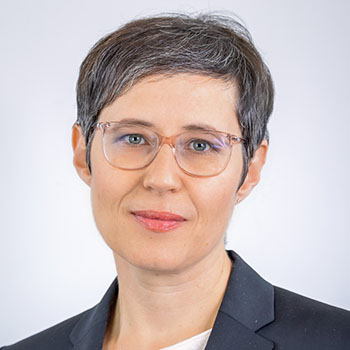
Franziska Hohl Zürcher
Franziska Hohl est sociologue. Ses travaux se situent à l’intersection de la sociologie du droit, de la sociologie des organisations et de la sociologie de la connaissance. Elle est actuellement chercheuse postdoctorante dans le cadre du projet Aqua-criminalité – un fléau impuni, où elle étudie les pratiques de poursuite pénale en matière de criminalité liée à l’eau. Ses recherches portent notamment sur la répartition des compétences et des responsabilités entre autorités pénales et administratives, organisations non gouvernementales et acteurs privés, ainsi que sur la pertinence des « non-savoirs » dans le traitement des infractions environnementales.
Entre 2013 et 2025, elle a pris part à plusieurs projets de recherche dans le domaine de droit pénale et de procédure pénale. Dans le projet Revamping Anticorruption Criminal Law – Strategies and Consequences (RevACLaw), elle a analysé les pratiques de poursuite pénale dans différents pays, en particulier le recours à la justice négociée dans des affaires de corruption transnationale, ainsi que les enjeux de transparence – ou de manque de transparence – tant du côté des autorités judiciaires que des entreprises condamnées.
Dans le cadre du projet Intercepter avec des interprètes, elle s’est intéressée aux processus formels et informels de définition des rôles entre policiers et interprètes/traducteurs d’interception, à la manière dont ces acteurs gèrent les arbitrages quotidiens entre exigences procédurales et nécessité de pratiques informelles, ainsi qu’à la production de preuves par des non-juristes tels que les interprètes/traducteurs.
Sa contribution au projet The Changing Face of Criminal Trial, mené à la Faculté de droit de l’Université de Bâle, a donné lieu à sa thèse de doctorat. À travers une étude expérimentale, elle y démontre comment différents styles de procès-verbaux d’interrogatoire de police influencent la perception des juges pénaux suisses (Université de Berne, 2021).
Franziska Hohl est titulaire d’un lic. phil. en sociologie, histoire, et langue et littérature arabes, ainsi que d’un Bachelor en administration des affaires. Elle a par ailleurs travaillé dans divers instituts de recherche, institutions publiques et entreprises privées.
Activités scientifiques
Post-doctorante au projet « Aqua-criminalité – un fléau impuni » financé par le FNS.
Publications
(2024). Role making in translational contexts: A qualitative study on the different roles of intercepts interpreters/translators in covert communication surveillance (avec C. Griebel). Translation in society.
(2024). Redefining interpreters’ and translators’ roles : unveiling forensic expertise in lawful interception of communication (avec N. Capus). Revista Estudos Institucionais 10/2, pp. 689-712.
(2024). La justice négociée dans la corruption transnationale – entre transparence et confidentialité (avec N. Capus, éds). Basel: Helbing Lichtenhahn.
(2024). Revamping Anticorruption Criminal Law – The Making of (In-)Transparency (avec N. Capus). In: Capus, N. & Hohl Zürcher, F. (Eds.). La justice négociée dans la corruption transnationale – entre transparence et confidentialité. Basel : Helbing Lichtenhahn, 15-47.
(2023). The work of intercept interpreters in lawful communication surveillance: a daily trade-off between formal requirements and informal needs (avec C. Griebel). International Journal of Law, Crime and Justice 74.
(2022). Reduced statement credibility in interpreter-mediated interviews (avec N. Capus et M. Stoll). International Journal of Speech, Language and the Law 29/2: 124-144.
(2022). Communicative (inter‐)action transcending the police investigative interview room (avec N. Capus). Language and Law/Linguagem e Direito, 9/2: 58-73.
(2021). Einvernahmeprotokolle lesen: Eine wissenssoziologische Untersuchung zur Rezeption von Einvernahmeprotokollen in schweizerischen Strafverfahren. (Thesis). Bern: Universität Bern.
(2017). Korrekturen in polizeilichen Vernehmungsprotokollen: Ein Risiko für die Verteidigung (avec N. Capus et M. Stoll). Monatsschrift für Kriminologie und Strafrechtsreform 100: 147-160.
(2016). Physische und verbale Übergriffe auf die Polizei. Empirische Erkenntnisse zu den Viktimisierungserfahrungen der Luzerner Sicherheitspolizei (avec N. Capus et S. Mundhaas). forum poenale 9/6: 357-365.
(2014). Einvernahmeprotokolle: Der Stil beeinflusst die Richter (avec N. Capus). Plädoyer 32: 30-35.
Conférences
(2024) Disclosure of corruption: Results from a Swiss study on the corporate offenders’ communication, presentation at the Annual Conference of the European Society of Criminology, Bucharest (Rumania), 11-14 September 2024
(2024) Communicating corporate corruption cases: a delicate dilemma for public prosecturs, presentation at the Annual Conference of the Research Committee on Sociology of Law (RCSL), Bangor (Wales, UK), 3-6 September 2024
(2023) Übersetzungsrealitäten und konstruierte Wirklichkeit in der geheimen Kommunikationsüberwachung [Translation realities and constructed reality in the secret surveillance of communication], presentation at the fifth congress of the German-speaking legal sociology associations, Innsbruck (Austria), 20-23 September 2023
(2023) Are intercept interpreters neutral translation machines or powerful language service providers? Results from a study within the legal borderlands of the secret surveillance of communication, presentation at the Socio-legal Studies Association Conference, Derry (Northern Ireland), 4th to 6th April 2023
(2022) Intercept interpreters in police communication surveillance: how many voices does law in action have in a multilingual context? (with Cornelia Griebel), presentation at the Swiss Network for Law & Society: Inaugural conference “Voices of Law”, Lausanne (Switzerland), 15./16.9.2022
(2022) Insights into interdisciplinary ethnographic research (with Cornelia Griebel), presentation at the Interdisciplinary Workshop on Collaborative Research and Writing, Neuchâtel, 5.5.2022
(2022) The work of interpreters in lawful surveillance of communication: A daily trade-off between formal requirements and informal needs (with Cornelia Griebel), presentation at the workshop for authors of the special issue « The politics of (in)formality in criminal procedures » of the International Journal of Law, Crime, and Justice, 7.3.2022
(2017) The interpreter: A disadvantage for foreign-language suspects in criminal proceedings, poster presentation at the conference of the Swiss Network for research on discrimination (SNDF/RSRD), Bern, 3.11.2017
(2016) Does lay participation in court affect the perception of statement credibility and suspect credibility? Insights from an empirical study with Swiss criminal law judges, presentation at the Conference of the European Society of Criminology, Münster (Germany), 22.9.2016
(2016) Rather a lay judge than a professional judge? Effects of legal education and judicial experience on the perception of credibility in criminal trials, presentation at the JDMx 2016 meeting (International conference for doctoral students), Basel, 10.6.2016
(2014) Impact and effects of police records in criminal law procedures (with an introduction of Nadja Capus), presentation at the Symposium « Recording in the Criminal Justice Process. Text, Sound, Image », Amsterdam (Holland), 2.12.2014
Fonction
Dr. rer. soc.
Post-doctorante FNS
Domaines de compétences
- Sociologie de la (non)connaissance
- Sociologie des organisations
- Bureaucratie (de première ligne)
- Production et réception de dossiers et de preuves
- Etudes socio-juridiques spécialisées en droit pénal et en procédure pénale
Adresse
Centre romand de recherche en criminologie
Rue A.-L. Breguet 1
2000 Neuchâtel
Bureau No 120
Contact
franziska.hohl@unine.ch
Tél. +41 32 718 15 57

