Home
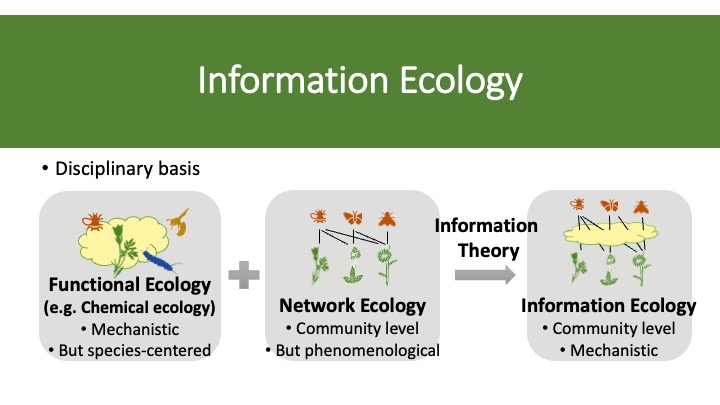
The Network, Information and Chemical Ecology (NICE) group aims to scale up the mechanistic understanding of species interactions from species to community level by integrating information theory into eco-evolutionary theories. The work combines empirical and theoretical aspects, and aims to deliver novel insights on how to improve ecosystem stability and sustainability under global changes.
Chemical communication is an ancient and ubiquitous channel to mediate species interactions (e.g., attracting, deterring) and plays important roles in connecting species, building interaction networks and affecting ecological services and functioning. Communication concerns signal transfer from senders to receivers and results in a fitness change for both parties. Moreover, a signal can also be eavesdropped upon by a third party, benefitting the eavesdropper without clear benefits for the sender. So far, most studies on chemical communication have focused on specific species isolated from whole ecological networks. In fact, deciphering community-level chemical communication is currently hampered by the lack of practical methodologies that would effectively scale up the number of interacting species without being overwhelmed by enormous amount of chemical information they produce, and more crucially, by the lack of testable conceptual theories.